VW Golf Engines for Sale – Genuine GTI, Golf R, TSI and TDI Engines
VW Golf Engines for Sale at Global OEM Car Parts are genuine Volkswagen engines for Golf owners and workshops replacing a failed or damaged engine. Current listings cover:
- Golf 7 GTI 2.0 TSI, code CHH
- Golf 8 R 2.0 TSI, code DSF
- Golf 7 1.6 TDI, code CXX
- Golf 8 2.0 TDI, code DSU
Each listing shows the engine code and the compatible Golf generation, along with what’s included where stated. Compare engines by code, generation and specification, confirm the match against your car, then order the engine that suits your repair.
Genuine OEM VW Golf Engines by Code and Generation
VW Golf engines vary by generation, fuel type and output, and the engine code identifies the exact variant. An OEM VW Golf engine with the correct code matches the mounts, wiring, engine management and emissions equipment your car was built with.
Our range covers the main Golf engine types:
- TSI gasoline engines for the GTI and Golf R
- TDI diesel engines for everyday Golf models
Owners choose a Volkswagen Golf replacement engine for several reasons:
- Engine failure
- Accident damage
- High-mileage wear
A replacement engine is often more economical than a full rebuild.
Every engine in this category is a genuine Volkswagen part.
VW Golf TSI, GTI, Golf R and TDI Engines Compared
The VW Golf engines in our range cover gasoline and diesel applications.
VW Golf GTI engines. The VW Golf 7 GTI engine, code CHH, is a 2.0 TSI turbocharged gasoline engine for the Golf 7 GTI.
VW Golf R engines. The VW Golf VIII R engine, code DSF, is a 2.0 TSI listed at 235 kW (320 PS) for the Golf 8 R.
VW Golf TDI diesel engines:
- VW Golf 8 2.0 TDI engine, code DSU, for 2019-onwards Golf 8 models
- VW Golf 7 1.6 TDI engine, code CXX, from a 2015 Golf 7, supplied without the particulate filter
Complete engines vs engine assemblies. Listings differ in what’s included. Some exclude items such as the particulate filter or transmission. Check each listing for turbochargers, intake, wiring, ECU and ancillaries.
Shop Used VW Golf Engines at Global OEM Car Parts
Our VW Golf engines for sale suit owners and workshops who want a genuine Volkswagen engine rather than an unknown rebuild. When comparing used VW Golf engines, start with the engine code, generation and condition on each listing.
On each listing, review:
- The engine code, such as CHH, DSF, DSU or CXX
- Compatible Golf generation and model year
- Fuel type and output
- Included and excluded parts: turbo, intake, wiring, ECU, particulate filter, transmission
- Mileage and condition where stated
- Photos of the engine code stamp, ports and any damage
Browse the VW Golf engines below and open each listing for full details. If you need a Golf engine code that isn’t listed, such as a 1.4 TSI or 1.5 TSI, contact us with your VIN.
How to Choose the Right VW Golf Engine Assembly
Match the engine code. VW uses many engine codes within each Golf generation. Find your code on the vehicle data sticker, usually in the spare wheel well or service book, or stamped on the engine block. Order an engine with the same code, or one confirmed as compatible.
Confirm generation and output. A Golf 7 GTI engine differs from a Golf 8 R engine in output, ancillaries and engine management. Diesel engines also differ between generations in emissions equipment. Check the listing against your car’s generation and model year.
Check what is included. Engine listings range from long blocks to complete engines with ancillaries. The Golf 7 1.6 TDI is listed without the particulate filter, for example. Budget for anything you need to transfer or buy separately.
Plan for ECU and immobiliser coding. Volkswagen engine control units are linked to the car’s immobiliser. A replacement engine usually needs your original ECU transferred, or coding with VW diagnostic equipment.
Check market and emissions requirements. Diesel and gasoline Golf engines vary between US and European specifications. Confirm the engine suits your market’s emissions rules before importing or fitting.
Use professional installation. Have the engine fitted by a VW specialist. They should replace fluids, filters, gaskets and timing components as needed, and check for fault codes after fitting.
Before you order, confirm your engine code and generation, check what’s included, and plan coding and installation with your VW specialist.
Frequently Asked Questions About VW Golf Engines
How do I find my VW Golf engine code?
Look at the vehicle data sticker, usually in the spare wheel well or service book, or at the stamping on the engine block. A VW dealer can also confirm the code from your VIN. Codes such as CHH, DSF, DSU and CXX identify the exact engine variant.
Can I fit a Golf GTI or Golf R engine in another Golf?
Not as a direct swap. GTI and Golf R engines differ in output, ancillaries, cooling and engine management, and a swap usually needs wiring, ECU and drivetrain changes. For a straightforward replacement, choose the same engine code your car left the factory with.
How much does a VW Golf engine replacement cost?
It depends on the engine, labour, parts transferred and coding. Our current Golf engines range from about $2,600 for the Golf 7 1.6 TDI to $4,350 for the Golf 8 R engine. Ask your installer for a full quote.
Will a replacement Golf engine need coding?
Usually. The engine control unit is linked to the immobiliser, so most replacements involve transferring your original ECU or adapting it with VW diagnostic equipment. A VW specialist can complete this.
Are your VW Golf TDI engines suitable for US cars?
Check before buying. Our TDI listings are European-specification engines, and emissions certification differs between markets. Confirm compatibility and legal requirements in your state or country before ordering.
Do you sell rebuilt engines or a VW Golf 1.4 TSI engine?
Our current listings are genuine used Volkswagen engines. We don’t currently list a rebuilt engine or a 1.4 TSI. Contact us with your VIN and engine code, and we’ll check what we can source.


vw golf engines
VW Crafter 6-Speed Gearbox – OEM Code TWX – Compatible with Crafter 2.0 TDI 140hp 4×4 – 2019


vw golf engines


vw golf engines
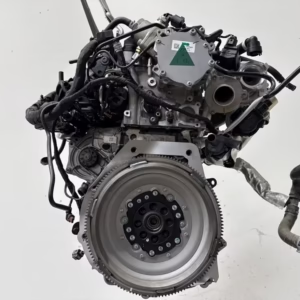

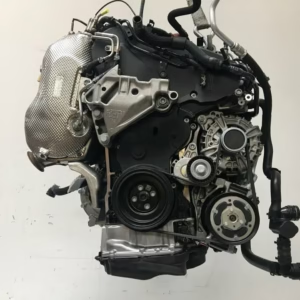
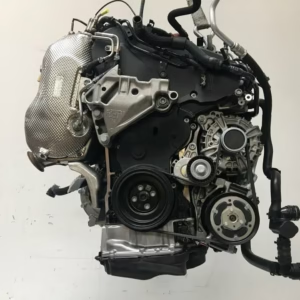
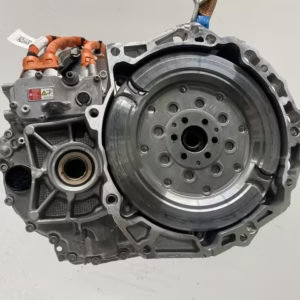
vw golf engines


vw golf engines
VW T-Roc 2.0 TSI Engine – OEM Code CZP – Compatible with T-Roc – 2018 (Transmission Not Included)
vw golf engines
VW Touareg 4.0 TDI Engine – OEM Code DMV – Compatible with Touareg 320kW/435hp – 2018